Accueil » Les numéros » 102. Multitudes 102. Printemps 2026 » Majeure 102. Imaginaires politiques des BRICS+

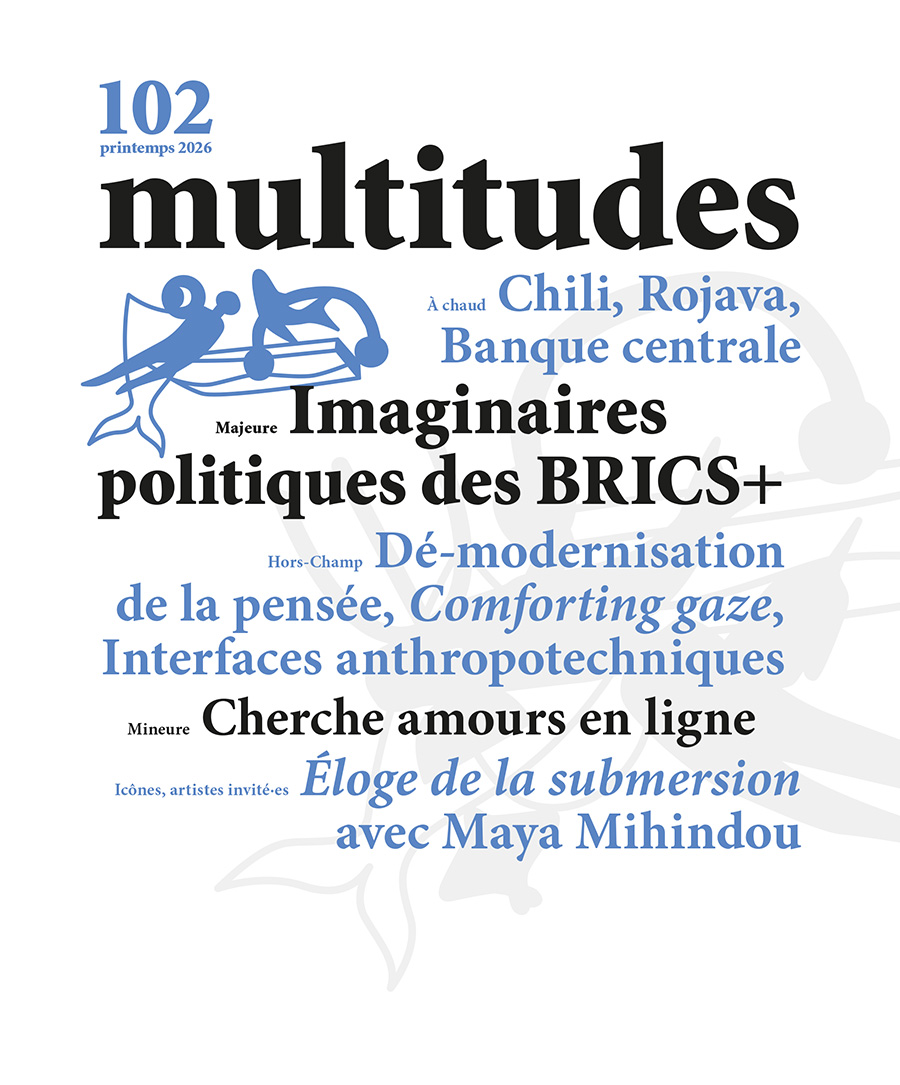
Majeure 102. Imaginaires politiques des BRICS+

Les États africains et les BRICS+
De l’attraction à l’illusion, par
et

Les BRICS+ vus de Jakarta 
La stratégie indonésienne du multi-alignement, par

Les BRICS+ vus de Jakarta
La stratégie indonésienne du multi-alignement
Cet entretien analyse les raisons de l’adhésion de l’Indonésie aux BRICS+ en 2024, en la replaçant dans la continuité d’une politique étrangère historiquement fondée sur le non-alignement, aujourd’hui réinterprété comme une stratégie de multi-alignement pragmatique. Cette décision s’explique à la fois par les contraintes rencontrées dans la candidature du pays à l’OCDE, par l’activisme diplomatique du président Prabowo Subianto et par la volonté d’affirmer un rôle d’acteur global au sein du « Sud global ». La discussion montre toutefois que l’Indonésie n’adopte pas une posture de rupture avec l’ordre international libéral : elle défend une évolution vers davantage d’inclusivité et critique les « doubles standards », tout en restant attachée aux principes universalistes issus de Bandung et du multilatéralisme onusien.

BRICS+ from Jakarta’s Perspective
Indonesia’s
Multi-Alignment Strategy
This interview analyses the reasons behind Indonesia’s accession to BRICS+ in 2024, placing it in the context of a foreign policy historically based on non-alignment, now reinterpreted as a pragmatic multi-alignment strategy. This decision can be explained by the constraints encountered in its application to join the OECD because of President Prabowo Subianto’s diplomatic activism, and the desire to assert a role as a global player within the “global South”. However, the discussion shows that Indonesia is not adopting a stance of breaking with the liberal international order: it advocates a move towards greater inclusiveness and criticises “double standards”, while remaining committed to the universalist principles of Bandung and UN multilateralism.

Des BRICS+ au Sud global
La stratégie d’influence informationnelle de la Chine en Afrique de l’Ouest francophone, par

Des BRICS+ au Sud global
La stratégie d’influence informationnelle de la Chine en Afrique de l’Ouest francophone
Pour favoriser l’acceptabilité de ses projets économiques et diplomatiques en Afrique de l’Ouest francophone, Pékin a mis en place un dispositif médiatique visant à diffuser des récits favorables autour de sa puissance. Dans cette stratégie, les médias chinois utilisent les BRICS+ pour construire l’image d’une organisation portée par la Chine, à travers des narratifs anti-impérialistes et multilatéralistes. En parallèle, les publications chinoises associent aux contenus pro-BRICS+ le concept de « Sud global » défendu par Pékin en Afrique francophone, cherchant à construire la représentation d’une Chine bienveillante et défenseuse de rapports équilibrés entre États. Une image qui apparait en contradiction avec l’influence de Pékin dans les relations sino-africaines (premier partenaire commercial du continent africain, leader des BRICS+ et du Sud global). Dès lors, les BRICS+ deviennent un objet informationnel dans la stratégie d’influence de Pékin qui manipule des représentations géopolitiques d’inspiration tiers-mondiste en vue de convaincre des audiences africaines francophones de la légitimité de sa présence sur le continent. Le récit pro-BRICS+ véhiculé par la Chine en Afrique produit ainsi l’illusion d’un multilatéralisme de Pékin, qui mène un projet de puissance aux caractéristiques impérialistes.

From BRICS+ to the Global South
China’s Strategy of Informational Influence in French-Speaking West Africa
To promote acceptance of its economic and diplomatic projects in French-speaking West Africa, Beijing has set up a media apparatus aimed at spreading favourable narratives about its power. As part of this strategy, the Chinese media are using BRICS+ to build the image of an organisation led by China, through anti-imperialist and multilateralist narratives. At the same time, Chinese publications associate pro-BRICS+ content with the concept of the “Global South” promoted by Beijing in French-speaking Africa, seeking to construct an image of China as a benevolent defender of balanced relations between states. This image appears to be at odds with Beijing’s influence in Sino-African relations (as the African continent’s leading trading partner, leader of BRICS+ and the Global South). As a result, BRICS+ has become an informational tool in Beijing’s influence strategy, which manipulates Third World-inspired geopolitical representations in order to convince French-speaking African audiences of the legitimacy of its presence on the continent. The pro-BRICS+ narrative promoted by China in Africa thus creates the illusion of Beijing’s multilateralism, which is in fact pursuing a power project with imperialist characteristics.

La Russie à la conquête des imaginaires africains
La « désoccidentalisation » comme récit stratégique, par
et

La Russie à la conquête des imaginaires africains
La « désoccidentalisation » comme récit stratégique
Cet entretien analyse la « désoccidentalisation » promue par la Russie comme un outil à la fois rhétorique et stratégique, mobilisé dans un contexte de déclin relatif de l’ordre international libéral. Les BRICS+ y occupent une place centrale, offrant à Moscou des ressources de résilience économique, diplomatique et symbolique depuis l’invasion de l’Ukraine. Ils constituent moins une alternative institutionnelle cohérente qu’un cadre diplomatique flexible, permettant d’articuler partenariats économiques, influence informationnelle et coopérations sécuritaires, notamment en Afrique. La discussion montre enfin que l’attractivité des BRICS+ repose sur leur capacité à capter les aspirations néo souverainistes du « Sud global » face à la délégitimation de l’« Occident collectif ».

Russia’s Conquest of the African Imagination
“De-Westernisation” as a Strategic Narrative
This interview analyses the “de-Westernisation” promoted by Russia as both a rhetorical and strategic tool, mobilised in a context of relative decline of the liberal international order. The BRICS+ countries play a central role in this, offering Moscow economic, diplomatic and symbolic resilience since the invasion of Ukraine. They constitute less a coherent institutional alternative than a flexible diplomatic framework, enabling the articulation of economic partnerships, informational influence and security cooperation, particularly in Africa. Finally, the discussion shows that the appeal of the BRICS+ countries lies in their ability to capture the neo-sovereignist aspirations of the “global South” in the face of the delegitimisation of the “collective West”.

Le Brésil, Lula et l’énigme des BRICS+
Le multipolarisme comme désert sans boussole, par

Le Brésil, Lula et l’énigme des BRICS+
Le multipolarisme comme désert sans boussole
À partir d’un événement organisé par l’agence de presse Sputnik Brasil en amont du sommet des BRICS+ à Rio de Janeiro de 2025, cet article examine les imaginaires politiques, les convergences idéologiques et les tensions internes qui traversent aujourd’hui le projet BRICS+. Il montre comment des registres discursifs hétérogènes – développementisme, anti-occidentalisme, récits civilisationnels autoritaires et imaginaires conspirationnistes – se recomposent autour d’une promesse multipolaire largement indéterminée, principalement portée par la Russie et la Chine. L’article interroge l’opposition entre « Occident » et « Sud global » qu’il analyse comme une construction réductrice masquant une crise globale de la démocratie. Il analyse enfin la place spécifique du Brésil et de Lula, non comme promoteurs d’une multipolarité démocratique, mais comme acteurs de légitimation symbolique d’un ensemble dominé par des régimes autoritaires, dont les ambitions géopolitiques, monétaires et institutionnelles demeurent largement déconnectées des conditions politiques et sociales qu’elles revendiquent.

Brazil, Lula and the Enigma of BRICS+
Multipolarism as a Desert without a Compass
Based on an event organised by the Sputnik Brasil news agency ahead of the BRICS+ summit in Rio de Janeiro in 2025, this article examines the political imaginaries, ideological convergences and internal tensions that currently characterise the BRICS+ project. It shows how heterogeneous discourses—developmentalism, anti-Westernism, authoritarian civilisational narratives and conspiracy theories—are being reconfigured around a largely undefined multipolar promise, mainly promoted by Russia and China. The article questions the opposition between the “West” and the “Global South”, which it analyses as a reductive construct masking a global crisis of democracy. Finally, it analyses the specific place of Brazil and Lula, not as promoters of democratic multipolarity, but as actors in the symbolic legitimisation of a group dominated by authoritarian regimes, whose geopolitical, monetary and institutional ambitions remain largely disconnected from the political and social conditions they claim to represent.

La politique juridique extérieure des BRICS+
Une coopération significative en matière d’environnement et de climat ?, par

La politique juridique extérieure des BRICS+
Une coopération significative en matière d’environnement et de climat ?
Cet article analyse l’émergence d’une politique juridique extérieure des pays du groupe BRICS+ dans le domaine du droit international de l’environnement et du climat. Il soutient que, loin de chercher à établir un ordre juridique alternatif, les BRICS+ privilégient une stratégie d’appropriation et de réinterprétation sélective du droit international existant, afin de mettre en avant les inégalités structurelles de la gouvernance mondiale et de promouvoir une lecture du multilatéralisme plus attentive aux intérêts du « Sud global ». Cette politique se manifeste par des prises de position communes, des initiatives institutionnelles et des mécanismes de coopération concrets, notamment en matière de financement climatique, de commerce durable et de marchés carbone. Il existe toutefois des limites à cette dynamique, dues aux profondes divergences internes entre les États membres quant à leurs trajectoires énergétiques et à leurs niveaux d’ambition climatique. L’influence des BRICS+ sur l’évolution de l’ordre juridique international dépendra de leur capacité à transformer ces convergences partielles en une action normative cohérente dans un système international profondément fragmenté.

The External Legal Policy of the BRICS+
Meaningful Cooperation on the Environment and Climate?
This article analyses the emergence of an external legal policy among the BRICS+ countries in the field of international environmental and climate law. It argues that, far from seeking to establish an alternative legal order, the BRICS+ countries favour a strategy of selective appropriation and reinterpretation of existing international law in order to highlight the structural inequalities of global governance and promote a reading of multilateralism that is more attentive to the interests of the “global South”. This policy is manifested in joint positions, institutional initiatives and concrete cooperation mechanisms, particularly in the areas of climate finance, sustainable trade and carbon markets. However, there are limits to this dynamic, due to deep internal divergences among member states regarding their energy trajectories and levels of climate ambition. The influence of the BRICS+ on the evolution of the international legal order will depend on their ability to transform these partial convergences into coherent normative action in a deeply fragmented international system.

Trump face aux BRICS+
Diviser pour tenter de régner, par

Trump face aux BRICS+
Diviser pour tenter de régner
Cette discussion analyse les effets du retour de Donald Trump sur l’ordre international et la place des BRICS+. Loin de favoriser un multipolarisme structuré, la présidence Trump II accélère le démantèlement de l’ordre international libéral au profit d’une logique fondée sur les rapports de force, les intérêts économiques et des convergences idéologiques illibérales. Les BRICS+ ne sont pas appréhendés comme un bloc homogène, mais comme un ensemble à fragmenter. L’administration Trump privilégie un noyau restreint – Russie, Inde, Chine – tout en marginalisant d’autres membres et en contournant les cadres multilatéraux. La rupture avec l’usage normatif du droit international, l’arsenalisation de l’économie et l’affaiblissement du soft power américain contribuent à la fragmentation de l’« Occident global ». Cette recomposition ne stabilise pas un nouvel ordre multipolaire mais installe un désordre stratégique durable.

Trump faces BRICS+
Divide and Rule
This discussion analyses the effects of Donald Trump’s return on the international order and the place of the BRICS+. Far from promoting structured multipolarism, Trump’s second term is accelerating the dismantling of the liberal international order in favour of an approach based on power relations, economic interests and illiberal ideological convergences. The BRICS+ are not seen as a homogeneous bloc, but as a group to be fragmented. The Trump administration favours a small core group—Russia, India, China—while marginalising other members and circumventing multilateral frameworks. The break with the normative use of international law, the weaponisation of the economy and the weakening of American soft power are contributing to the fragmentation of the “global West”. This reconfiguration is not stabilising a new multipolar order but is creating lasting strategic disorder.

Multitudes en images

Penser l’art brut aujourd’huiLiliana Porter + Ana Tiscornia. Coup de foudreOù allons-nous vivre maintenant ?Cartes, caryographies, diagrammes, etcAntonio Gallego & José Maria GonzalezApprentissage – Extinction – Résurrection / Grégory Chatonsky & Ariel KyrouIcônes 54Multitudes 53-54
multitudes